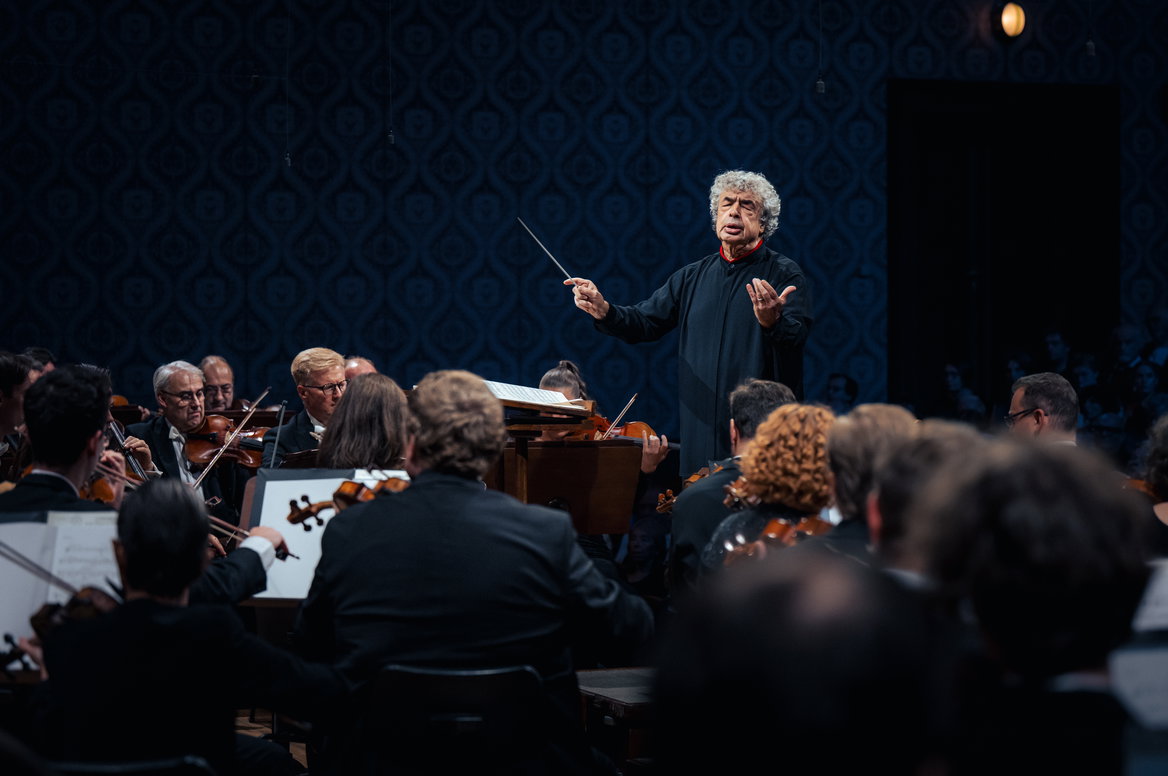
According to Semyon Bychkov, a conductor must be obsessed with music. Bychkov satisfied that criterion at an early age, when Sergei Rachmaninoff was one of his obsessive preoccupations. He did not yet realise how closely the works of the Russian composer would be linked to his own life.
At the age of 20, Bychkov won the conducting competition bearing the composer’s name, and when he was denied the prize—conducting the Leningrad Philharmonic—he decided to leave the Soviet Union permanently. So it was that in 1975 he arrived in New York with 50 dollars in his pocket and with just a single contact: the niece of Sergei Rachmaninoff. He was welcomed with open arms, and today among his possessions are his beloved composer’s briefcase and some of his scores.
Pianist Behzod Abduraimov calls his relationship with music the most important thing in his life. At the age of eight, when he did not feel like practising, his mother suggested that he could give up the instrument completely. “At first, I thought: is it this easy? I was happy for a few hours and then I realised I felt empty, even at such a young age! My attraction to music was much stronger than the fear of practising. What I want to say is that the realisation of being born with music came very early.”
Critics worldwide have hailed Abduraimov as a naturally gifted musician, with some describing him as a performer audiences “should keep their eyes on” and others praising his playing for his “magical touch”.
At the Rudolfinum the Uzbek native will play Rachmaninoff’s Third Piano Concerto, which so fiendishly difficult the composer joked he had written it for an elephant. He dedicated the work to the Polish pianist Josef Hofmann, but Hoffmann was unable to play it, having hands that were too small. Rachmaninoff surely did not suffer from that problem, having fingers that could reach notes a foot apart at the interval of a twelfth. There is another anecdote about the concerto connected with the piano virtuoso Vladimir Horowitz, who played Rachmaninoff’s music frequently. Finding himself bored during a hospital stay, he began counting the notes, but he lost count at the end of the first movement.
Abduraimov calls Rachmaninoff’s concerto a concert symphony of 29,600 notes. And he has the music at his fingertips (literally and figuratively).