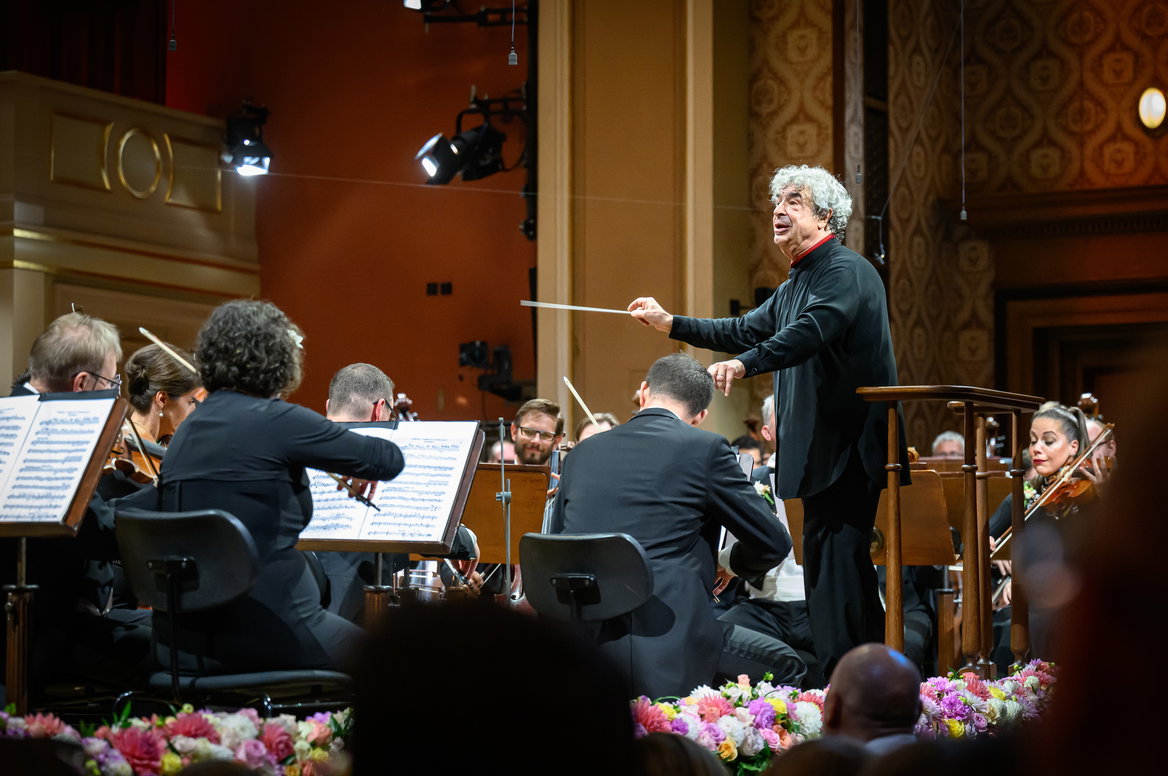
“I had conducted Dvořák’s symphonies many times before I arrived in Prague, but once I began leading the Czech Philharmonic, I discovered new layers in them. Now, it’s no longer ‘their’ Dvořák or ‘my’ Dvořák. It’s ‘our Dvořák’.”
– Semyon Bychkov
According to the chief conductor of the Czech Philharmonic, Dvořák’s Seventh Symphony represents the point at which he showed fully what he had within him. The composer finished writing the work in March 1885, and already by April he was conducting the very successful premiere at London’s St. James Hall. “The symphony was well liked and the audience acknowledged me and welcomed me in the most ostentatious fashion. There was pandemonium after every movement, rousing to the very end, just like at home”, the composer wrote in a letter to a friend two days after the performance. According to a similarly positive review in the Athenaeum, a London magazine, “Let it be said at once and decidedly that the new work fully satisfied the highest expectations that had been formed regarding it; and that his symphony in D minor is not only entirely worthy of his reputation, but is one of the greatest works of its class produced in the present generation.”
70 years after Dvořák’s Seventh Symphony, Shostakovich’s First Violin Concerto was well received at its premiere. According to David Oistrakh, the soloist on the occasion, the work is a real challenge for musicians: “It can be compared to a main role, a very deep Shakespearean role demanding the greatest emotional and intellectual devotion”. It was to Oistrakh that Shostakovich dedicated the concerto.
Janine Jansen regards Oistrakh as her great musical model. “On the one hand, one would like to play like he did. But how? We listen to recordings, of course, and we learn a lot from that. It’s always good to have lots of influences, but in the end, you have to do things your own way—with your own voice and your own feelings. Otherwise, it lacks sincerity and convincingness.” According to Jansen, authenticity must come before perfection. Otherwise, the result is empty. “Music is my voice. When playing the violin, I feel as if I’m singing or speaking. There’s no barrier between me and my instrument. The expression comes right out”, says the artist.