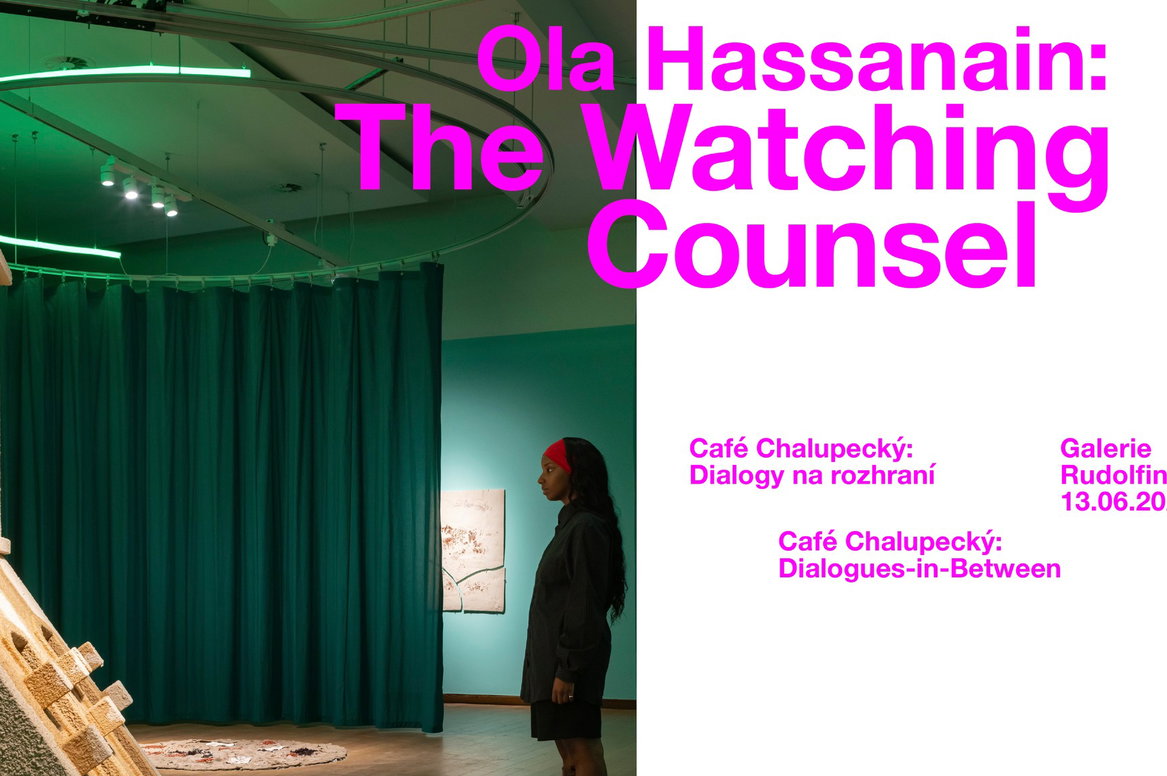
Café Chalupecký: In-Between-Dialogues | Ola Hassanain: The Watching Counsel DATAS: The Data and the Sovereign

Café Chalupecký: In-Between-Dialogues | Ola Hassanain: The Watching Counsel ⬩ DATAS: The Data and the Sovereign

We invite you to an accompanying event from the Café Chalupecký series organized by the Jindřich Chalupecký Society, held in conjunction with the exhibition DATAS: The Data and the Sovereign at Galerie Rudolfinum. The event will take place on Saturday, June 13, from 1 pm to 6 pm in the Rudolfinum Ceremony Hall (Dvorana Rudolfina). Admission is free.


Conception: Ola Hassanain
Participating artists: Pelumi Adejumo, Simnikiwe Buhlungu, Critical Tech Group, Tamara Kametani, Magdi Masaraa & JJJJJerome Ellis, Vojtěch Radakulan, Marie Tučková
Curator: simona markel dvorák
Dramaturgy cooperation: Tereza Jindrová
Organizational cooperation: Inka Jelínek Jurková (Goethe-Institut), Eva Drexlerová (Galerie Rudolfinum)
Production: Zlata Borůvková, Ondřej Houšťava (SJCh), Jan Čejka, Natálie Rajnišová (Galerie Rudolfinum)
Graphic design: Štěpán Marko
Communication: Petra Švecová (SJCh), Maja Ošťádalová, Tereza Kunderová (Galerie Rudolfinum)


The Watching Counsel


“Thinking globally, what we really have is a poverty–hunger–habitat–energy–trade–population–atmosphere–waste–resource problem, none of whose separate parts can be solved on their own.”


Sylvia Wynter’s On Being Human as Praxis (2015), reflection on what it means to be human within cycles of catastrophe


The Watching Counsel addresses the notion of (un)habitability in relation to ecological, political instabilities and the fragmented realities of the present. It generates new forms of care, participation and collective agency. Conceived and spatially designed by artist and architect Ola Hassanain, the project unfolds in dialogue with curator simona markel dvorák. Together, they foreground the intensifying interconnectedness of global events that increasingly destabilize and fragilize life at its deepest levels, calling for renewed awareness of the interdependence between places, bodies, species, politics, and climate. The project presents contributions by invited artists within a soundscape that permeates the Rudolfinum Ceremony Hall in Prague.


Ola Hassanain’s practice investigates how political, ecological, and historical systems become visible through built environments. Following this approach, The Watching Counsel creates a temporarily shared space punctuated by sound compositions, performances and reflections on a unified planetary body – from the changing color, texture and flow of river water to war-related displacement and ecological devastation. These catastrophes are linked to global struggles over land, gold, lithium, and other extractive resources. The project also asks what material and social conditions these processes create for the future and what form of “ecology of repair” are we able to imagine today?


Here, Hassanain develops a mode of attention anchored in witnessing/watching, in which understanding emerges not from data, but from presence, relationships and the ability to listen. The installation does not strive for unambiguous answers; rather, it opens a space for perceiving what often remains hidden, and for tracing connections between seemingly unrelated events that are understood here as deeply implicated.


The conceptual and visual core of the installation consist of clay islands with hibiscus, responding to the presence of water and light. They reference Ola Hassanain’s grandmother’s house in the Gezira region, part of one of Africa’s largest agricultural schemes. Built in the 1930s alongside new irrigation infrastructures, the house was gradually destabilized as changes and mismanagement of water supply altered the clay soil, eventually causing structural cracks and collapse. These materials thus connect personal experience with broader themes of infrastructure, environmental change and the climate crisis.


Watching and Counsel become forms of open-ended propositions for noticing, listening, and responding to what feels broken. It reflects on re-story-ation in which witnessing and watching became a gesture of care and attentiveness, to shared presence among human, land and all species.


About the dramaturgy of Café Chalupecký: In-Between-Dialogues


For more than ten years, the Jindřich Chalupecký Society has been organizing Café Chalupecký meetings, inviting mainly foreign curators, theorists, artists to get to know the Czech art scene and create their own interpretations in relation to Czech art of the present and the recent past. As part of that program simona markel dvorák was invited to design the extended version called In-Between-Dialogues. These assemblies unfold in the spirit of Jindřich Chalupecký’s legacy, envisioning art not merely as a reflection of society but as a site of intervention and responsibility. Rooted in his commitment to translocal dialogue and the social dimensions of artistic practice, the gatherings extend his vision into the urgencies of the present. Through Chalupecký’s extensive correspondence and his belief in cooperative exchange across borders and generations, we are reminded of the necessity of thinking across geographies, temporalities, and lived experience, an approach that resonates with intersectional feminist practice. In this way, the new dialogues bridge the historical conditions of his epoch with the fractured realities of today, holding open a space where critical reflection and collective imagination might converge.


The Watching Counsel is also part of the accompanying public program for the exhibition DATAS: The Data and the Sovereign, an international art and research project that brings together artists, theorists, and technological experts to explore how digital infrastructures, artificial intelligence, and algorithmic governance affect personal and political sovereignty. DATAS explores the mechanisms of surveillance capitalism, technological extractivism, and the erosion of democratic agency. In this context, we will be interested in: what communication tools, data technologies and energy infrastructures are used for civilian and military purposes, and who really benefits from these differences. We are also interested in how decisions on climate change, the transformation of the social justice and security landscape are presented – often unclearly, illegibly – and who are the real actors and interests that influence these decisions.


Acknowledgments


With the kind support of Ministry of culture of the Czech Republic, City of Prague, Goethe-Institut Sudan, Goethe-Institut Czech Republic, Mondriaan Fund  and programme Culture Moves Europe.


The DATAS: The Data and the Sovereign project is co-funded by the European Union under the Creative Europe programme.

Free entry

More information about the event can be found on the Galerie Rudolfinum website.

Galerie Rudolfinum